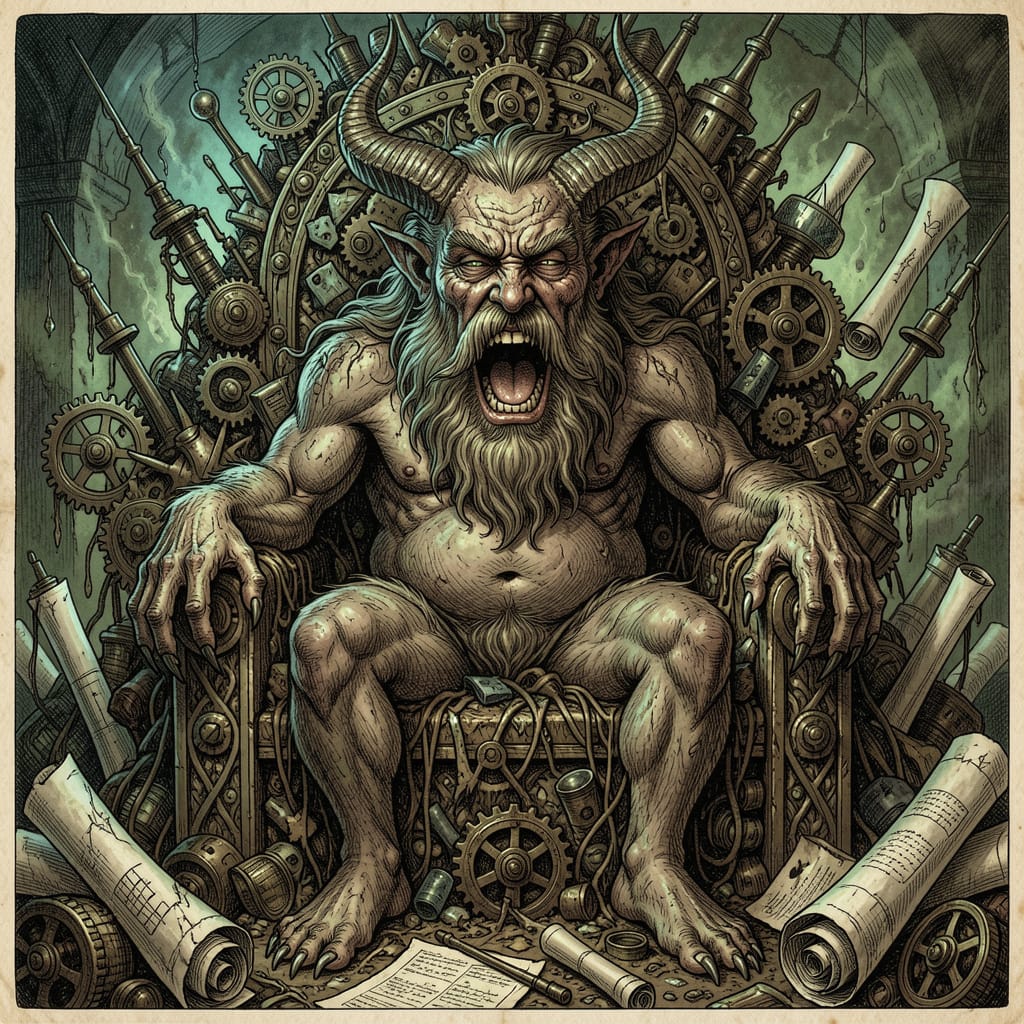
Baal-Peor appears in Numbers 25, in the episode at Shittim: the Israelites, encamped on the plains of Moab, attach themselves to the Moabite god, joining in his sacrifices and rites, which the text associates with licentiousness. The apostasy provokes a divine plague; the priest Phinehas intervenes with a violent act that ends it, and the worshippers are put to death. The local god of Moab becomes, in the Hebrew tradition, a byword for transgression and idolatrous seduction — the foreign cult that draws the faithful away through appetite.
The transition from Moabite deity to demon of Hell followed the familiar path by which the god of a rival people becomes the evil spirit of later theology. By the medieval period Belphegor had acquired his full demonological character: the demon who tempts through ingenious inventions, promising fame and wealth through discovery, and drawing his victims into greed, procrastination, and ruin through their own ambition. In Binsfeld's 1589 classification he is the chief demon of Sloth, the office he holds among the Seven.
His appearance in the literature is notably doubled. He can manifest as a beautiful naked woman — the seductive promise of the idea, the perfect vision before execution — or as a monstrous bearded demon with horns, sharp claws, and a gaping, permanently open mouth, enthroned on a seat of filth. The open mouth is characteristic and much remarked. His fullest literary treatment is comic: Niccolò Machiavelli's novella Belfagor arcidiavolo (published 1549), in which the demon is sent up from Hell to discover whether marriage is truly the misery the damned claim it to be, takes a wife, is ruined by her, and flees back to Hell convinced that human life is unendurable.
Belphegor's domain is the subtlest of the seven, because it does not look like a vice at all. Sloth, in its theological sense — acedia — is not simple laziness but a spiritual listlessness, a failure to care, a refusal to take joy in the good and to make the effort it asks. Belphegor's genius is that he arrives disguised as its opposite: as inspiration, as brilliant possibility, as the idea so perfect it hardly seems to need the doing.
The trap is the gap between conception and execution — the opening that is his very name. The idea stands whole and shining in the mind; the work of making it real can only be laborious and diminishing; and so the work is never begun, or never finished, and the brilliance curdles into apathy. What looked like ambition becomes paralysis. The peculiar cruelty of sloth as Belphegor wields it is that it feels, from the inside, not like failure but like peace — the calm of a man who has decided, without quite noticing, that nothing is worth the trouble of starting.